
The Firefighting Trap: Why Reactive Operations Can’t Do Kaizen
Every operations leader I’ve ever met knows they should be doing more kaizen.
They know the fires they’re putting out today are connected to problems they didn’t fix last month.
They know the corrective actions sitting open on that spreadsheet are going to come back as something worse. They know the team is capable of more; if only there were time to actually improve something instead of just keeping everything from falling apart.
And then the shift starts, and it happens again.
This is the firefighting trap. And it is one of the most common — and most expensive — patterns in manufacturing.
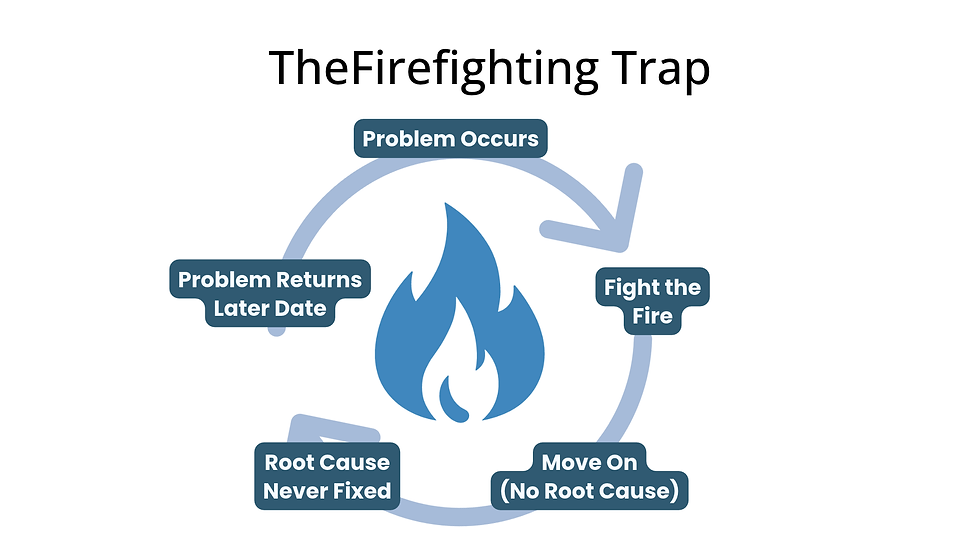
How the Trap Works
The firefighting trap isn’t a character flaw. It’s a system problem.
When an operation runs without standard work, every deviation becomes a crisis. When there’s no visual management, problems hide until they’re urgent. When corrective actions never get verified, the same issues resurface — slightly different, same root cause.
Each fire demands immediate attention. And each fire that gets fought instead of fixed makes the next one more likely.
The team isn’t lazy. They’re exhausted. They’re spending every hour of every shift keeping the operation from getting worse — and none of it on making it better.
“You are doing firefighting because you’re not doing kaizens, because you’re not pausing, you’re not looking at it, you’re not fixing problems from the cause, and you’re not going to be out of that circle unless you change that behavior.”
That’s not a motivational challenge. That’s a systems challenge.
Why Kaizen Gets Deprioritized
The irony of the firefighting trap is that the solution — kaizen, structured problem-solving, root cause analysis — feels like a luxury when the floor is on fire.

There’s always a reason to skip it. A job that has to ship. A customer who called. An equipment issue that needs attention right now.
And so the improvement event gets pushed. The A3 stays half-finished. The problem-solving culture never gets traction — not because nobody wants it, but because the system never creates the conditions for it.
This is why lean transformation fails more often than it should. Not because the tools don’t work. Because the organization never gets quiet enough to use them.
Breaking the Cycle
Getting out of the firefighting trap requires a deliberate pause — one that most operations feel they can’t afford.
The argument against pausing is always the same: we’re too busy. There’s too much going on. We’ll do it next quarter when things settle down.
Things don’t settle down. They compound.
The operations that break the cycle do it by making one decision: we are going to stop one fire permanently before we fight the next one. Not contain it. Not log it. Find the root cause, fix it, verify the fix held, and make sure it doesn’t come back.
That single shift in behavior — from reaction to resolution — is where lean culture begins.
What It Takes
Breaking the firefighting trap requires three things:
A structured method. Every problem solved differently means nothing gets solved consistently. Teams need A3 thinking, 5 Why analysis, and structured containment — so problem-solving becomes a repeatable skill, not a one-time heroic effort.
Visibility into open issues. Leaders can’t coach a process they can’t see. When corrective actions are tracked visually, with clear ownership and verified closure, the team builds accountability into the workflow.
Protected time. Kaizen doesn’t happen around the edges of a full schedule. It requires a deliberate commitment from leadership to protect the time — and hold the line when the floor pushes back.
None of this is easy in the middle of a busy operation. But the alternative is clear: stay in the trap, fight the same fires, and absorb the cost of a system that never improves.

The Way Out
Lean was never supposed to be a project with a start and an end date. It’s a discipline — the daily, deliberate effort to make the system a little better than it was yesterday.
The firefighting trap is what happens when that discipline doesn’t exist. And the way out isn’t a better firefighting process. It’s building the system that makes firefighting unnecessary.
That is what Techam is here to help you build.

